


 Decrease Font
 Auto Tuning
 Increase Font

The First Municipal Innovation Hackathon
Together we innovate to enhance municipal development and the urban economy.
As part of the First Municipal Innovation Forum in the Al-Baha region, a hackathon competition will be held to attract innovators, entrepreneurs, and creative thinkers to participate in creating innovative solutions to the proposed challenges.
About the Hackathon:
The Municipal Innovation Center for Entrepreneurship, under the General Directorate of Institutional Excellence and Governance, oversees the organization of the First Municipal Innovation Hackathon. This high-level competition aims to attract creative minds to provide applicable solutions to the urgent urban challenges presented.
Hackathon Objectives:
Developing practical and innovative solutions to improve the efficiency and quality of basic municipal services in the Al-Baha region.
Transforming creative ideas into applicable entrepreneurial project models that meet the needs of the municipal sector and contribute to local development.
Creating solutions and projects based on the concept of smart cities to enhance sustainability and attract high-value investments.
Innovating advanced technological applications and solutions to address municipal challenges and support tech-driven entrepreneurial projects.
Innovation Campaigns in the Hackathon:
Supporting municipal innovation in traditional sectors.
Encouraging municipal investment in new sectors.
Attracting entrepreneurial projects across various municipal fields.
Hackathon Challenges:
The hackathon challenges revolve around finding high-quality and innovative solutions within the following main themes:
Innovation in Basic Municipal Services:
Challenge: Developing entrepreneurial solutions to improve waste management efficiency and reduce traffic congestion in cities.
Examples: developing smart waste collection systems, technology-based waste tracking, using big data and AI to analyze traffic, improving road safety under difficult conditions, increasing the efficiency of public lighting.
How can smart systems be developed to collect waste and determine container locations effectively?
How can residents be encouraged to sort waste at the source using technology?
How can technology be used to track waste from the source to treatment and disposal sites?
How can big data (Big Data) and artificial intelligence be used to analyze traffic and identify congestion points?
How can mobile applications be developed to help drivers find alternative routes and avoid congestion?
How can public transportation be improved and encouraged to reduce reliance on private cars?
How can technology enhance road safety and help drivers during difficult conditions such as fog or heavy rain?
How can early warning systems be developed to alert drivers of hazardous conditions?
How can night-vision technology or fog sensors be used to improve visibility in difficult conditions?
How can autonomous driving systems be developed to assist driving when visibility is low?
How can smart lighting technologies be used to save energy and improve the efficiency of public lighting?
How can renewable energy be used to power public lighting systems?
How can smart public lighting systems be designed to adapt to traffic movement and weather conditions?
Entrepreneurship in the Municipal Sector:
Challenge: Providing the necessary support and resources for entrepreneurs and developing innovative business models for smart cities.
Examples: developing services to meet customer needs, using technology to improve customer experience, measuring customer satisfaction.
How can municipal services be developed to meet customer needs and expectations while improving current procedures?
How can technology enhance customer experiences with municipal e-services and introduce innovative new services?
How can customer satisfaction with municipal services be measured and areas for improvement identified?
Smart Cities and Investment:
Challenge: Developing smart city infrastructure projects and encouraging municipal investments in tourism.
Examples: renewable energy projects for facilities, designing smart and sustainable infrastructure, smart resource management, eco-friendly tourism projects, designing smart industrial zones.
How can innovative projects relying on solar and wind energy be developed to power municipal facilities?
How can innovative financial models be designed to encourage investment in renewable energy projects?
How can incentives be provided to investors in the renewable energy sector?
How can technology be used to design smart and sustainable city infrastructure?
How can IoT (Internet of Things) be used to improve public facility management?
How can smart solutions be developed for managing water, electricity, and waste in cities?
How can eco-friendly tourism projects be developed in the Al-Baha region?
How can technology support eco-tourism and cultural tourism promotion?
How can infrastructure in tourist areas be improved while preserving the environment?
How can smart and sustainable industrial zones be designed?
How can investments be attracted to new industrial areas?
How can an attractive business environment be created for investors in industrial zones?
Technology and Entrepreneurship in the Municipal Sector:
Challenge: Supporting entrepreneurial projects that achieve sustainable urban development and developing innovative solutions for environmental and social challenges.
Examples: improving air quality, increasing green spaces, developing apps for municipal services, AI for decision-making, AR/VR for planning.
How can innovative entrepreneurial projects be developed to improve air quality and reduce pollution?
How can entrepreneurial projects increase green spaces in cities?
How can entrepreneurial projects improve waste management and encourage recycling?
How can mobile applications facilitate access to municipal services?
How can apps be developed for reporting city issues?
How can apps encourage community participation in municipal work?
How can technology improve municipal service efficiency and reduce costs?
How can AI enhance decision-making in municipal operations?
How can big data (Big Data) improve citizen needs analysis and service delivery?
How can entrepreneurial projects support sustainable water resource management?
How can renewable energy be used in cities as part of entrepreneurial projects?
How can biodiversity be preserved in the Al-Baha region through entrepreneurial initiatives?
How can AR (Augmented Reality) and VR (Virtual Reality) improve urban planning?
How can 3D printing be used to create models for municipal projects?
How can blockchain enhance municipal data security and transparency?
How can technology increase community participation in municipal decision-making?
How can digital platforms facilitate communication between citizens and municipal authorities?
How can citizen awareness of the importance of community participation in municipal work be improved?
Who Can Participate?
Entrepreneurs and creative thinkers.
Individuals interested in city development and municipal services.
University students and graduates.
Developers and designers.
Architects and civil engineers.
Basic Participation Requirements:
The participant must be a Saudi national.
The participant must be 18 years old or above.
Forming a team of 3–5 members.
The participant must not be an official employee of the municipal or housing sector in the Al-Baha region.
Benefits Provided in Cooperation with Experienced Success Partners:
Valuable benefits for the top three winners in each category.
Project Incubation:
The opportunity to incubate winning projects and provide the necessary support for development.
Project Promotion:
Through various municipality channels to increase the chances of success.
Mentorship Mechanism:
Mentors play a vital role in supporting participating teams during the hackathon. Mentors are selected from experts and specialists in the challenge areas. Each team will be connected to one or more mentors through the digital platform. Mentors are expected to guide the teams in developing their ideas, building initial business models, preparing final pitches, and answering inquiries.
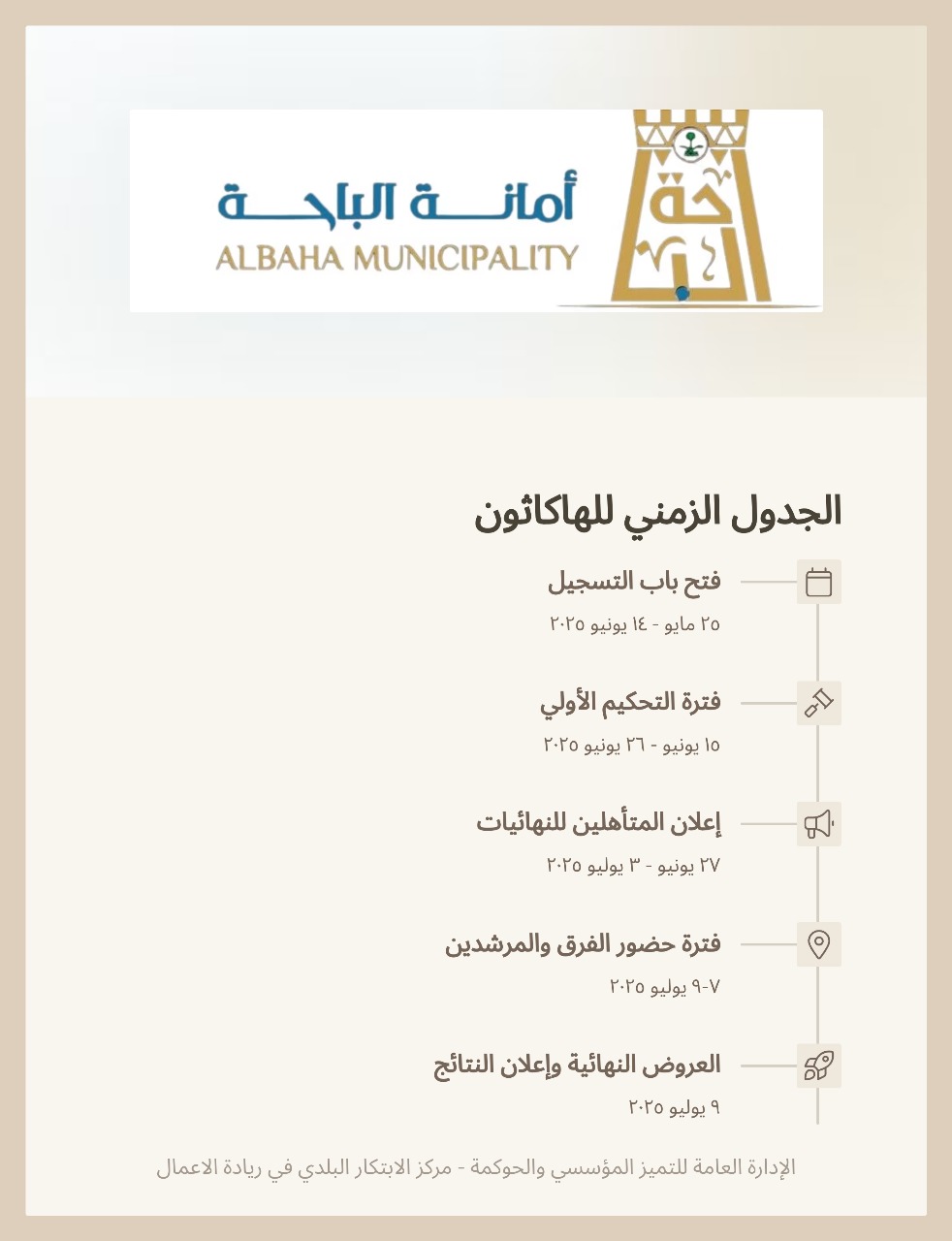
Hackathon Timeline:
To view the non-disclosure agreement and regulatory requirements Click here
Form your team, choose your challenge, and innovate for the future of Al-Baha!

